Solar geometry, eclipse exposure and terrain shadow define generation and storage demand.

ACROS LUNAR OUTPOST ARCHITECTURE
CELESTIQ
PRIME
MAGELLAN creates the route.
PRIME makes permanence operable.
A compact permanent outpost for six people—engineered to remain safe, repairable and useful when Earth cannot help immediately.
DESIGN BASIS / 6 CREW + 4 SURGESIX REGULAR / TEN TEMPORARY MAXIMUMCOMPACT · ISOLATABLE · REPAIRABLE · EXPANDABLE
CELESTIQ PRIME / 001NOT A FLAG. A FUNCTION.
01
THE OPERATING PREMISE
The first form of permanence
is not architecture.
It is recovery.
PRIME begins when a lunar site can absorb a late delivery, a failed power element, a damaged seal or an unavailable vehicle without turning every fault into evacuation.
Rockets are the courier.
Infrastructure is the plot.
02
BEFORE THE FIRST FOUNDATION
The Moon is not empty land.
It is an operating environment.
PRIME does not begin by choosing a photogenic crater. The site is selected by the systems that must survive there and the traffic that must operate around it.
Slope, bearing strength, hazards and traversability determine landing, unloading and growth.
Landing plumes, ejecta and crash corridors must remain physically removed from inhabited assets.
Communications, navigation, resource routes and emergency return shape the usable site.
Local cycles determine radiator geometry, storage protection and maintenance exposure.
Water and useful regolith are opportunities only after prospecting proves quantity and accessibility.
THE PHYSICAL ARRIVAL
Landing is not the end
of the flight.
It is the first live interface with the outpost. Guidance, terrain clearance, plume separation and vehicle safing must hand a delivered payload to an operating surface system—not merely place it somewhere on the Moon.
PHASEFINAL APPROACH
RADAR ALTITUDE24.8 m
VERTICAL RATE-0.70 m/s
LATERAL RATE0.03 m/s
MAIN ENGINE42 %
LANDING RADARTRACK
ATTITUDENOMINAL
CABIN PRESSURE101.1 kPa
03
ACROS LUNAR OUTPOST / DESIGN BASIS 0.1
The core stays small.
The safety architecture does not.
This top-down operating plan is sized for six regular occupants and a temporary maximum of ten. It exposes the compact pressure core, independent refuge and the stand-off distances normally erased from lunar-base imagery.
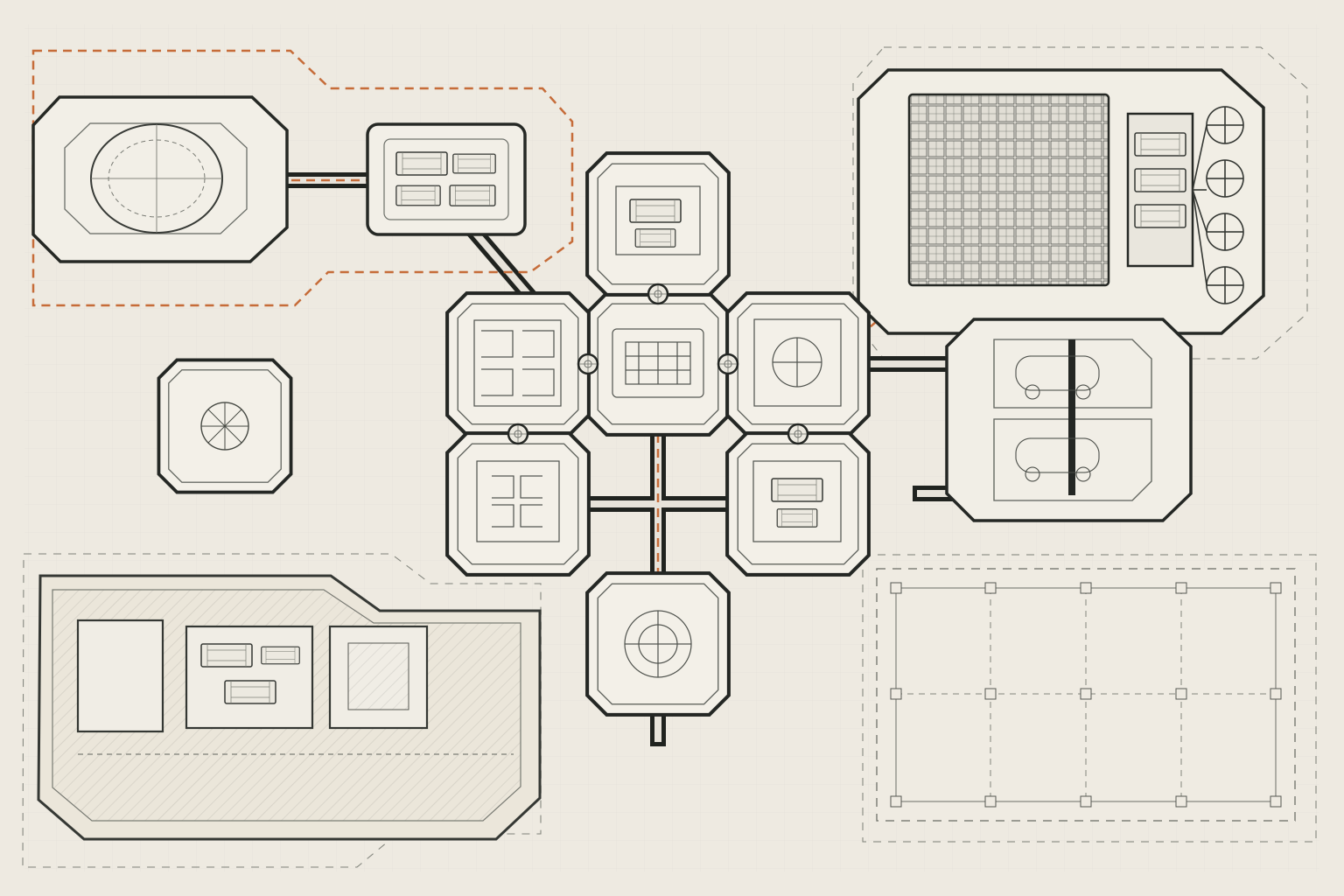
LANDING EXCLUSION / HAZARD ENVELOPERESERVED OPERATIONAL ENVELOPE
THE OPERATING SURFACE
A base is measured
in movement.
PRIME is not experienced as one building. It is a network of protected routes between pressure, power, logistics, maintenance and emergency functions.
TRAVERSE MODECREWED / LOW SPEED
GROUND SPEED3.2 km/h
ROUTESERVICE CORRIDOR 01
DISTANCE TO AIM18 m
TERRAIN GRADE2.4°
UTILITY CLEARANCENOMINAL
RETURN PATHVERIFIED
LOCAL COMMSMESH LOCK
04
THE ACROS OPERATING STACK
Ten systems.
One permanent outpost.
The architecture begins with survival, maintenance and human continuity. Science, prospecting, construction and eventual resource operations may use PRIME—but they do not define it.
01SITE & LANDING ZONETerrain, illumination, communications, access and plume effects determine where PRIME can begin—and where it can safely grow.
OPEN SYSTEM LAYER
OPERATING FUNCTIONACROS QUALIFICATION PATHSurvey → digital site model → robotic preparation → operational landing trial → PRIME site acceptance Follow the ACROS development architecture ↗
Convert survey evidence into a controlled site plan with separated landing, habitation, power, construction and emergency zones.
- CRITICAL INTERFACES
- Terrain model · navigation · surface mobility · communications · cargo flow
- PRIMARY FAILURE
- Landing dispersion or ejecta crosses an occupied or mission-critical zone.
- REQUIRED EVIDENCE
- Integrated landing-and-unloading demonstration on representative terrain with measured plume and debris effects.
02POWER & STORAGEDistributed generation, protected cabling and layered storage keep survival systems alive through eclipse, maintenance and local failure.
OPEN SYSTEM LAYER
OPERATING FUNCTIONACROS QUALIFICATION PATHCell → power string → zonal microgrid → integrated load trial → PRIME energy acceptance Follow the ACROS development architecture ↗
Supply critical and discretionary loads through independently isolatable generation, storage and distribution zones.
- CRITICAL INTERFACES
- Thermal control · habitats · communications · excavation · ISRU
- PRIMARY FAILURE
- A common bus fault or extended shadow exposure removes more than one supposedly redundant branch.
- REQUIRED EVIDENCE
- Representative eclipse cycle with one generation branch and one storage element unavailable while critical loads remain powered.
03PRESSURE ARCHITECTUREEight to ten standardised modules and four connection nodes form a compact, isolatable core for six regular occupants.
OPEN SYSTEM LAYER
OPERATING FUNCTIONACROS QUALIFICATION PATHPressure article → standard module → connected core → crew emergency trial → PRIME pressure acceptance Follow the ACROS development architecture ↗
Separate living, command, medical, science and service functions without creating one vulnerable pressure volume.
- CRITICAL INTERFACES
- Structure · hatches · shielding · utilities · emergency refuge
- PRIMARY FAILURE
- A penetration, seal failure or fire propagates beyond the affected module before isolation is complete.
- REQUIRED EVIDENCE
- Integrated outpost test with compartment loss, ten-person refuge occupancy and representative regolith loading.
04THERMAL & LIFE SUPPORTHeat rejection, atmosphere, water recovery and consumables are managed as one operating budget—not separate equipment lists.
OPEN SYSTEM LAYER
OPERATING FUNCTIONACROS QUALIFICATION PATHLoop hardware → environmental subsystem → occupied test volume → degraded-mode campaign → PRIME ECLSS acceptance Follow the ACROS development architecture ↗
Maintain habitable temperature, atmosphere and water inventory across normal, degraded and maintenance states.
- CRITICAL INTERFACES
- Power · radiators · habitats · crew load · water processing
- PRIMARY FAILURE
- Heat-rejection loss and consumable imbalance combine faster than the crew can isolate and recover the affected loop.
- REQUIRED EVIDENCE
- Closed-duration integrated test through peak heat load, partial loop isolation and delayed resupply conditions.
05CREW & HUMAN CONTINUITYSleeping, hygiene, nutrition, exercise, privacy and workload are engineered for six people—not treated as leftover volume.
OPEN SYSTEM LAYER
OPERATING FUNCTIONACROS QUALIFICATION PATHHuman factors model → occupied module → integrated crew campaign → PRIME continuity acceptance Follow the ACROS development architecture ↗
Sustain health, performance and social continuity through long-duration occupancy and temporary surge to ten.
- CRITICAL INTERFACES
- Life support · medical · food · privacy · operations
- PRIMARY FAILURE
- Crowding, fatigue or loss of a basic crew function degrades judgment faster than hardware can compensate.
- REQUIRED EVIDENCE
- Long-duration occupied campaign including privacy, shift handover, ten-person surge and degraded crew-system operation.
06COMMUNICATIONS & NAVIGATIONLocal positioning, surface relays and Earth links create the shared operational picture required before traffic increases.
OPEN SYSTEM LAYER
OPERATING FUNCTIONACROS QUALIFICATION PATHRadio node → local mesh → surface navigation network → loss-of-link exercise → PRIME network acceptance Follow the ACROS development architecture ↗
Provide resilient local positioning, asset tracking, command links and Earth connectivity without one line-of-sight dependency.
- CRITICAL INTERFACES
- Power · surface vehicles · landing guidance · mission control · crew systems
- PRIMARY FAILURE
- Terrain masking or relay loss produces an untracked vehicle, blind landing corridor or isolated crew element.
- REQUIRED EVIDENCE
- Network trial with deliberate relay loss, degraded Earth contact and autonomous continuation of time-critical local operations.
07MECHANICS & REPAIRA compact workshop, spares and two rover bays determine whether a technical fault remains local or ends the mission.
OPEN SYSTEM LAYER
OPERATING FUNCTIONACROS QUALIFICATION PATHProcedure → workshop cell → fleet trial → constrained repair campaign → PRIME maintenance acceptance Follow the ACROS development architecture ↗
Diagnose, fabricate and repair with constrained inventory while keeping dust and dirty work outside clean circulation.
- CRITICAL INTERFACES
- Configuration data · machine tools · electronics · spares · vehicles
- PRIMARY FAILURE
- One unavailable tool, bay or specialist turns a repairable fault into loss of surface capability.
- REQUIRED EVIDENCE
- Repair campaign with remote-support delay, one bay unavailable and substitute processes required.
08CONSTRUCTION & REGOLITHExcavation, grading, shielding, roads and foundations convert local material into protection and useful geometry.
OPEN SYSTEM LAYER
OPERATING FUNCTIONACROS QUALIFICATION PATHTool head → excavation unit → construction cell → full-scale placement trial → PRIME civil works acceptance Follow the ACROS development architecture ↗
Prepare terrain and place verified regolith structures without contaminating mechanisms, radiators or inhabited volumes.
- CRITICAL INTERFACES
- Mobility · dust control · power · site plan · habitat loads
- PRIMARY FAILURE
- Dust ingress, uncertain soil behaviour or placement error produces unusable shielding, foundation shift or damaged equipment.
- REQUIRED EVIDENCE
- Representative excavation and placement campaign with mass accounting, dust measurement and post-load structural survey.
09MEDICAL & EMERGENCYThe next surgical team, hospital bed or rescue vehicle is at least 3.5 days away under ideal conditions.
OPEN SYSTEM LAYER
OPERATING FUNCTIONACROS QUALIFICATION PATHClinical concept → medical module → crew simulation → delayed-rescue campaign → PRIME medical acceptance Follow the ACROS development architecture ↗
Stabilise trauma or illness, isolate infection and preserve treatment capability when another outpost system is unavailable.
- CRITICAL INTERFACES
- Independent oxygen · diagnostics · pharmacy · power · communications · refuge
- PRIMARY FAILURE
- The initiating emergency also removes access, pressure, supplies or the only medically trained crewmember.
- REQUIRED EVIDENCE
- Autonomous stabilization exercise with delayed evacuation, blocked primary access and limited specialist support.
10OPERATIONS & RECOVERYConfiguration, inspection, fault management and acceptance criteria bind every subsystem into a settlement that can be trusted.
OPEN SYSTEM LAYER
OPERATING FUNCTIONACROS QUALIFICATION PATHOperating rule → subsystem procedure → integrated control room → failure campaign → PRIME operational acceptance Follow the ACROS development architecture ↗
Maintain a shared configuration, operating picture and recovery logic across crews, vehicles, infrastructure and mission control.
- CRITICAL INTERFACES
- Every PRIME system · MAGELLAN cadence · BEES turnaround · Earth support
- PRIMARY FAILURE
- Conflicting configuration data or coupled faults defeat local priorities and consume recovery time faster than it is available.
- REQUIRED EVIDENCE
- Full mission campaign with injected cross-system failures, delayed delivery and formal return-to-service decisions.
05
FROM ROUTE TO REGOLITH
Delivery is not arrival.
Arrival is not operation.
PRIME begins at the point where the transport architecture hands mass to a surface organisation capable of receiving, moving, connecting and accepting it.
Recurring cislunar transport and encounter cadence.
Module handling, servicing and transfer preparation.
Autonomous LH₂/LOX lunar delivery and return.
Separated arrival, safing and cargo release.
Inspection, transport, placement and connection.
Acceptance into an operating lunar system.
One landing is an event.
A verified turnaround is infrastructure.
06
ACROS MATURITY STATES
Growth is permitted
only after survival is proven.
These are qualification states rather than project phases. Each state is earned through evidence and operating capability—not through a date on a presentation.
Prove the uncrewed infrastructure.
Landing separation, power, communications, pressure integrity and robotic recovery are verified before a resident crew is committed.
GATE / THE SITE IS SAFE TO OCCUPYProve six-person operation.
Life support, crew systems, workshops, medical response and surface mobility function together through normal and degraded states.
GATE / SIX PEOPLE CAN LIVE, WORK AND RECOVERRemove evacuation as the default answer.
Spares, isolation, refuge, maintenance and consumable margins allow the outpost to absorb credible failures and delayed resupply.
GATE / A LOCAL FAILURE DOES NOT END THE OUTPOSTAdd users without weakening the core.
Science, construction or industrial pilot systems connect through qualified interfaces and remain removable from the survival architecture.
GATE / NEW USE DOES NOT CREATE NEW FRAGILITY07
ONE POSSIBLE USER OF PRIME
Ice is not a base.
A crane is not infrastructure.
Resource work may become one customer of the outpost. It remains peripheral until the complete chain works at useful rate, purity and reliability.
- 01PROSPECTLocate and characterise
- 02EXTRACTExcavate and capture
- 03PURIFYRemove contaminants
- 04ELECTROLYSESeparate H₂ and O₂
- 05LIQUEFYReach cryogenic state
- 06STOREControl boil-off
- 07QUALIFYVerify propellant quality
- 08TRANSFERClose the LH₂/LOX loop
08
WHAT MUST BE PROVEN
Confidence is not a milestone.
Evidence is.
PRIME advances through demonstrations that expose the real interfaces: dust, mass, heat, distance, maintenance and human response.
Demonstrate precision cargo delivery, plume-safe stand-off and repeatable unloading.
REQUIRED OUTPUT / TEST RECORD + ACCEPTANCE DECISIONIsolate the fault, preserve critical loads and restore generation without evacuating the site.
REQUIRED OUTPUT / TEST RECORD + ACCEPTANCE DECISIONProve compartment isolation, atmosphere recovery and thermal stability across representative operating cycles.
REQUIRED OUTPUT / TEST RECORD + ACCEPTANCE DECISIONTransfer delivered modules from the landing zone to prepared foundations with controlled interfaces.
REQUIRED OUTPUT / TEST RECORD + ACCEPTANCE DECISIONMaintain treatment, isolation and critical care through at least the 3.5-day external-response interval.
REQUIRED OUTPUT / TEST RECORD + ACCEPTANCE DECISIONReceive, service and dispatch surface and transfer assets against defined acceptance criteria.
REQUIRED OUTPUT / TEST RECORD + ACCEPTANCE DECISION09
DESTINATION ENVIRONMENT / THE MOON
The Moon does not negotiate
with assumptions.
These conditions are neither background scenery nor isolated equipment problems. They form one survival environment around the crew. ACROS converts measured facts, variable events and unresolved effects into testable system requirements.
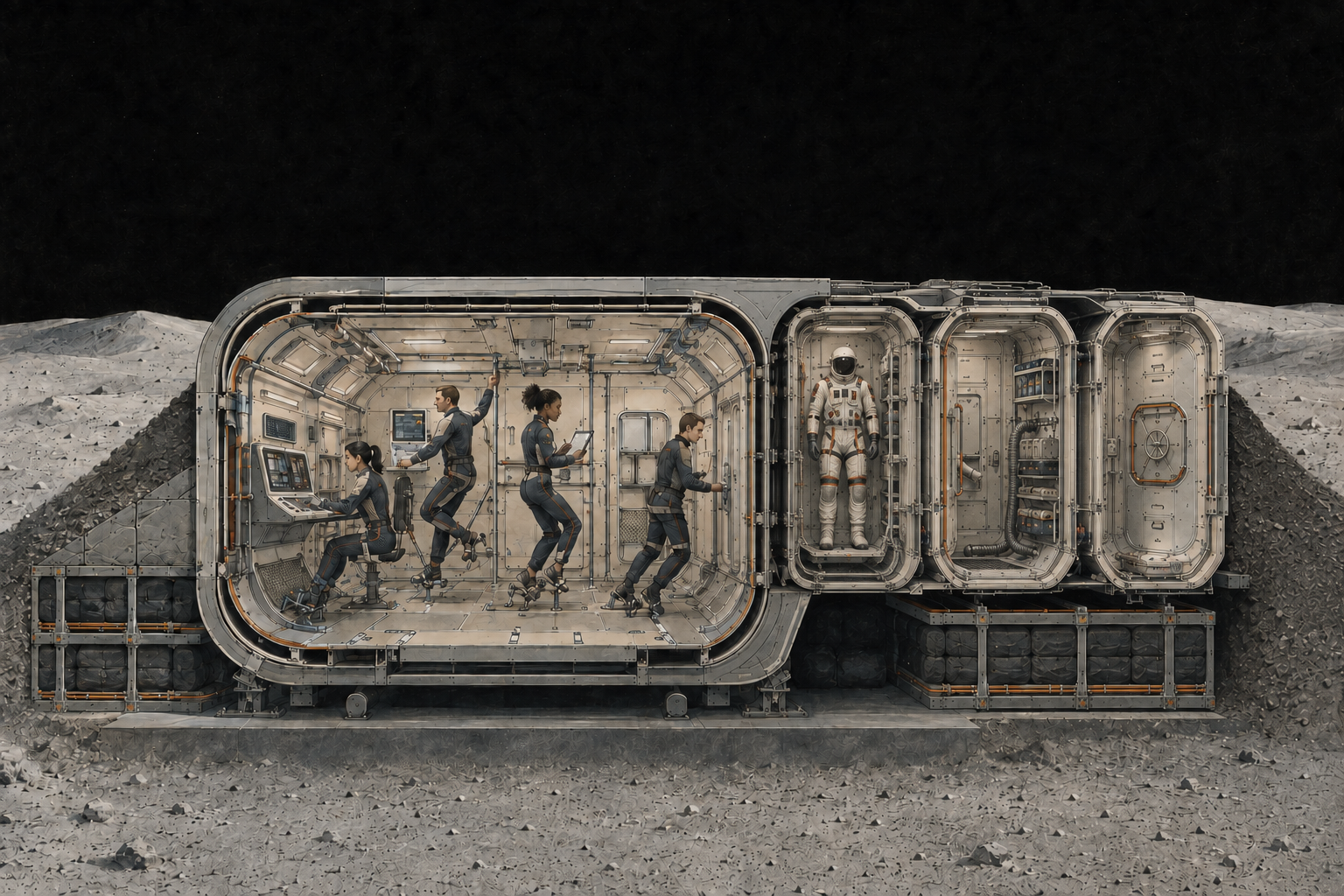
01 / MEASURED / CHANG’E-4 LND57.1 ± 10.6 µSv/hGalactic cosmic radiation
PHYSICAL BASIS
Continuous charged-particle exposure at the lunar surface.
OPEN SYSTEM QUESTION
Crew dose changes with shielding geometry, body self-shielding and solar cycle.
ACROS EVIDENCE
Validate inhabited shielding as a complete mass and geometry system.
CELESTIQ PRIME
Not the dream of the Moon.
Its operating draft.
The architecture does not promise sudden autonomy. It builds a controlled path from delivered shelter to a lunar site capable of sustaining work, absorbing failure and returning value to the wider CelestiQ network.
Not an anthem.
A blueprint.
MAGELLAN→CELESTIQ PRIME→CONNECTED ARCHITECTURE
The route delivers possibility. The surface must turn it into continuity.
Discuss PRIME ↗