MAGELLAN departs the Earth encounter on a translunar trajectory while incoming cargo is integrated and prepared.
CISLUNAR TRANSPORT ARCHITECTURE
MAGELLAN
Modular Architecture for Gravity-Enabled Earth–Lunar Logistics, Assembly and NavigationNamed for Ferdinand Magellan · c. 1480–1521
The orbit carries the distance.
The system carries what comes next.
Reusable cislunar transport architecture for sustained movement between Earth and Moon.

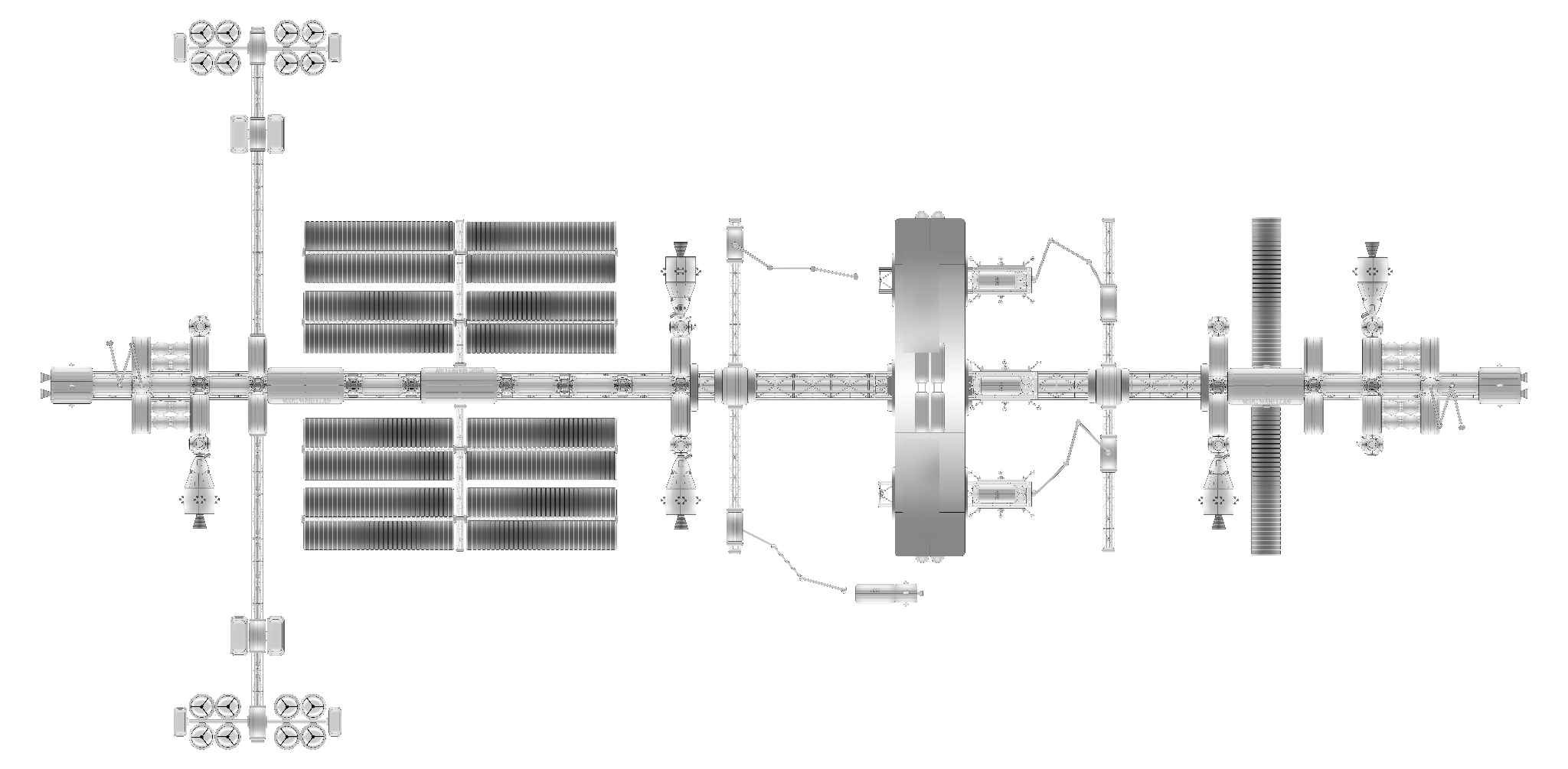
SYSTEM ARCHITECTURECOMPLETE PLAN VIEWRECURRENT / NOT EXPENDABLE
MAGELLAN / 001THE ROUTE BECOMES INFRASTRUCTURE
THE MACHINE IN MOTION
Architecture has dimensions.
Infrastructure has presence.
MAGELLAN is not conceived as a vehicle that completes one flight and disappears. It is a permanent cislunar asset: assembled in orbit, maintained in motion and repeatedly encountered by the vehicles moving through its route.
02
THE RECURRENT CYCLE
The trajectory does not consume the system.
It brings it back.
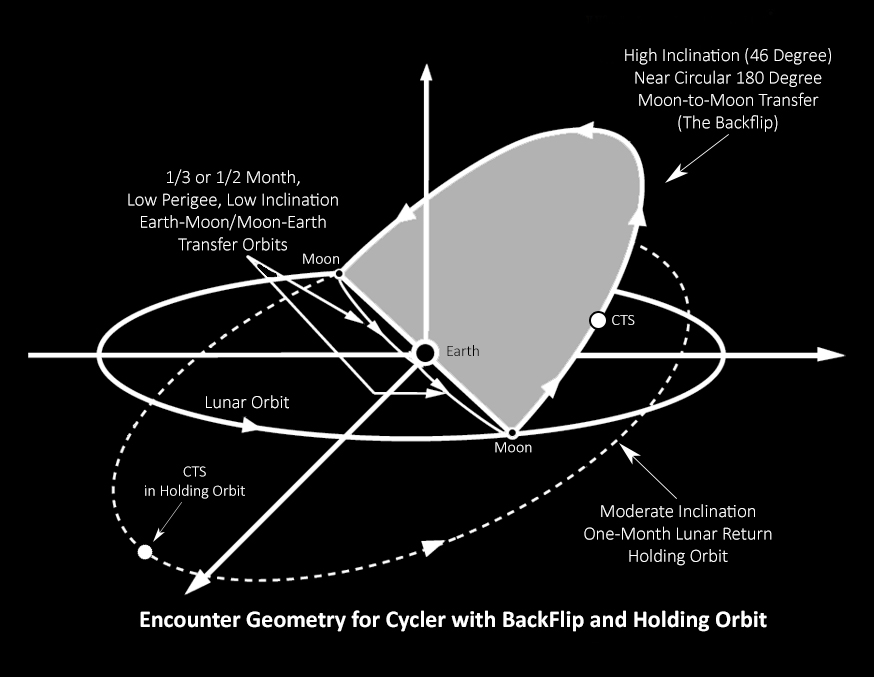
The BackFlip uses lunar gravity to redirect MAGELLAN into a high-inclination, near-circular Moon-to-Moon transfer. The trajectory class has been examined through numerical cislunar studies; MAGELLAN translates that orbital principle into a transport architecture.
Bees and their payloads separate before lunar passage. The Moon provides the swing-by that initiates the BackFlip.
A 180-degree transfer at approximately 47 degrees inclination returns the Cycler to the Moon’s new position.
Recovered vehicles are serviced and refuelled before MAGELLAN re-enters the Earth-return leg of the cycle.
A SINGLE 28-DAY SEQUENCE EXPLAINS THE MOTION. HOLDING ORBITS AND MULTIPLE CYCLERS CREATE THE OPERATIONAL NETWORK.
03
THE MOVING HANDOVER
Cargo changes vehicles.
MAGELLAN never leaves the route.
Select each phase to run it once. The sequence shows where cargo is released, captured and transferred—not merely where the Cycler flies.
PHASE 00THE RECURRENT ORBITRECURRENT ORBIT
MAGELLAN remains on its 28-day route while cargo changes vehicles around it.
The 28-day operating route.
120 TREFERENCE MANIFEST PER OUTBOUND LUNAR DELIVERY SEQUENCEUP TO 120 T TOTAL PAYLOAD · BEES VEHICLE MASS EXCLUDED
04
THE UPHOFF–CROUCH GEOMETRY
The route can recur.
The geometry does not stand still.
MAGELLAN adopts the BackFlip cycler geometry developed by C. Uphoff and M. A. Crouch. Their work established the orbital basis; MAGELLAN develops it into a transport architecture.
Lunar Cycler Orbits with Alternating Semi-Monthly Transfer Windows was presented by C. Uphoff and M. A. Crouch in 1991 and published in the Journal of the Astronautical Sciences in 1993.
The illustrated 28-day cycle is not an endlessly repeating rail. After successive BackFlip passages, MAGELLAN must leave the immediate sequence and enter a holding orbit.
Lunar distance, inclination and encounter geometry change throughout the real orbit. The next passage is therefore targeted and corrected—not assumed from an idealised diagram.
ENGINEERING STATUSPHYSICALLY CALCULATEDNUMERICALLY STUDIEDNOT YET DEMONSTRATED IN FLIGHT
 HOVER / TAP · OPEN BRIEF
PLATE 01 / OPERATING BRIEFWHY A HOLDING ORBIT?
The BackFlip is a calculated transfer, but it is not an endlessly repeatable railway. An immediate repeat under useful prograde, low-energy conditions would eventually demand an unusable lunar encounter. MAGELLAN therefore alternates the active Earth–Moon–Moon–Earth sequence with a one-month lunar-return holding orbit.
≈28 DAYSONE HOLDING CIRCUIT≈ LUNAR DISTANCEAROUND EARTHFEW M/SMONTHLY TARGETING ORDER
- WHAT THE VEHICLE DOES
- It completes a wide circuit around Earth while the Moon advances into geometry suitable for the next controlled encounter.
- WHAT OPERATIONS DO
- The pause becomes useful time for tracking, inspection, repair, robotic servicing and preparation of the next transfer window.
- WHY NOT FORCE THE PASS?
- Late correction becomes expensive. Small, early targeting manoeuvres are the credible way to protect the next lunar swing-by.
- WHAT HAS BEEN PROVEN?
- The sequence was physically calculated and numerically studied by Uphoff and Crouch. This specific logistics cycle has not been demonstrated in flight.
The holding orbit preserves the vehicle and turns a geometric constraint into an operational interval for targeting, inspection and servicing.
 HOVER / TAP · OPEN BRIEF
PLATE 02 / NETWORK BRIEFWHY TWO CYCLERS?
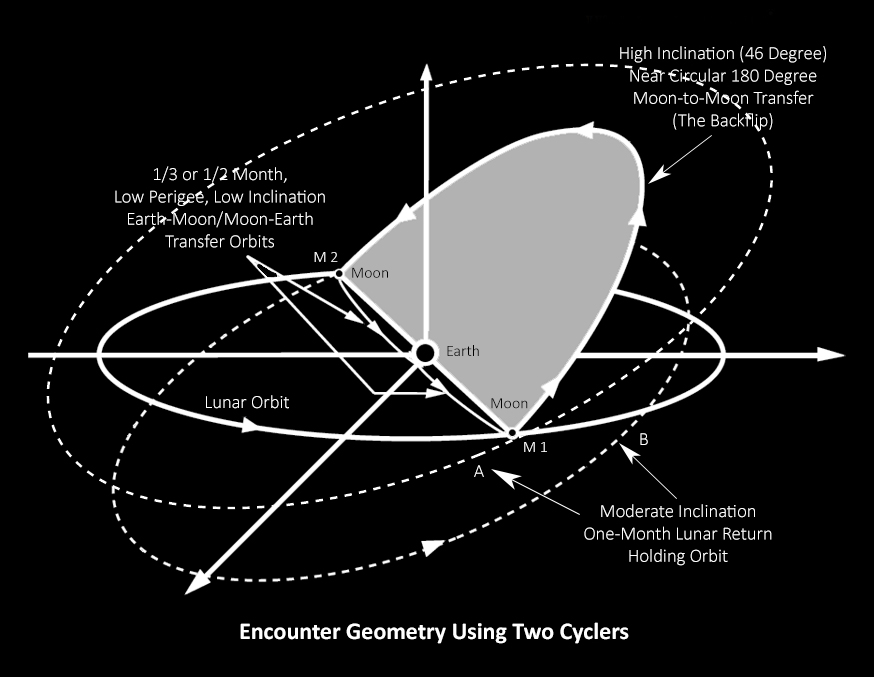
A second vehicle does not fly beside the first. The two Cyclers are phased so that one can serve an active transfer window while the other occupies the complementary holding sequence. The result is a transport cadence rather than a single-vehicle timetable.
2 / MONTHEARTH-RETURN WINDOWS3 MONTHSREPEATING ROLE PATTERN1.5 MONTHSPOSSIBLE JOINT ENCOUNTER
- HOW THE ROLES ALTERNATE
- One Cycler follows the BackFlip and Earth-return leg; the other remains in, or emerges from, its one-month holding orbit.
- WHY PHASING MATTERS
- Both vehicles must be assigned to the correct lunar encounter. Sending the wrong Cycler Earthward can disrupt the sequence and create a service gap.
- WHAT THE NETWORK GAINS
- Semi-monthly opportunities for cargo, crew and return logistics—without pretending that either vehicle is continuously available.
- WHAT ELSE BECOMES POSSIBLE
- The Cyclers may meet to exchange supplies or personnel, support an emergency, or temporarily combine while another vehicle fills the open slot.
Two phased vehicles alternate active passages and holding phases, turning intermittent orbital opportunities into a more regular service.
The route is calculated.
The encounter must still be engineered.
05
THE MAGELLAN EXPLORER
One architecture.
Every system in view.
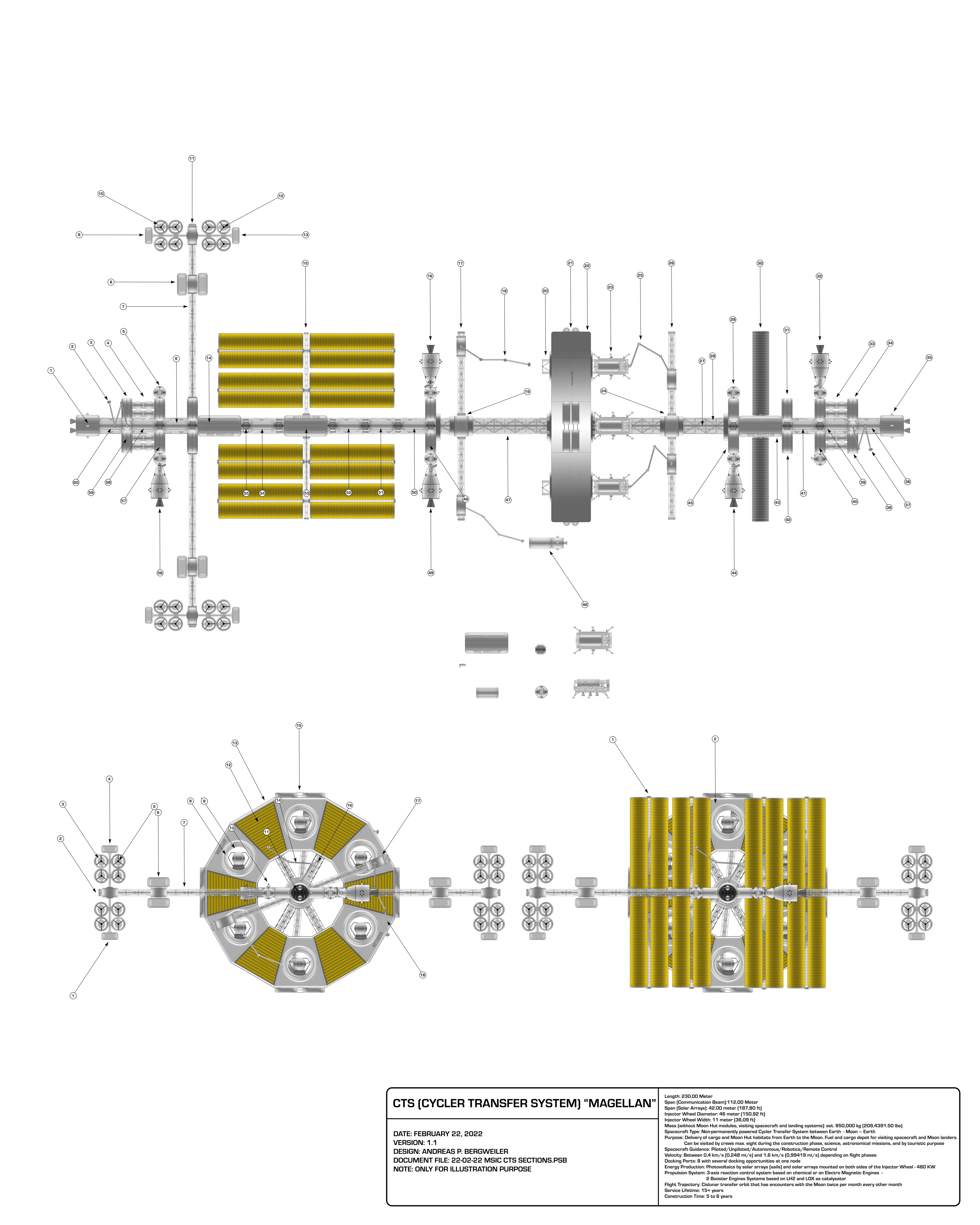
Move freely through the complete engineering plate. Use the technical index to navigate directly to any numbered system or module view.
MAGELLAN / ENGINEERING PLATE120%
06
THE TRANSFER CORE
HIATS
Habitat Injection Advanced Transfer System
MAGELLAN does not merely carry cargo.
HIATS processes it through the transfer cycle.
Developed as the architectural answer to moving several large pressurised modules through one Cycler, HIATS combines storage, utilities, robotic handling and deployment in a single ring structure.
01SIX MODULE POSITIONSUp to six habitat or cargo modules can be carried inside the protected transfer architecture.
OPEN SYSTEM BRIEF
THE REVOLVER
The octagonal HIATS ring is organised as a six-bay cargo garage. Each module remains individually accessible rather than becoming buried in a launch stack, allowing loading, servicing and release to follow the orbital sequence.
- CAPACITY
- 6 independent module positions
- ROLE
- Storage · access · routing
02LIVE UTILITIESUmbilical connections maintain electrical power and atmosphere while modules remain in transit.
OPEN SYSTEM BRIEF
PRESSURISED IN TRANSIT
Once secured in its bay, a module connects to MAGELLAN through service umbilicals. The ring’s own solar surfaces feed the transfer structure while onboard batteries retain the reserve required for separation and landing.
- SUPPLY
- Power · atmosphere
- RESERVE
- Module battery storage
03RAIL TRANSFERA controlled rail system moves each module between storage, integration and deployment positions.
OPEN SYSTEM BRIEF
FROM GARAGE TO LANDER
After robotic berthing, the module is placed onto the internal rail system and drawn into its cargo bay. At the calculated release point, the same guided path moves it across the ring to the waiting BEES transfer vehicle.
- PATH
- Capture · storage · handover
- CONTROL
- Mechanically constrained translation
04360° ROBOTICSMobile manipulator systems capture arriving modules and position them around the central structure.
OPEN SYSTEM BRIEF
BERTHING, NOT BLIND DOCKING
A free-moving manipulator travels along the ring axis while its elevator carriage rotates around MAGELLAN’s core. Together they capture a free-flying module, stabilise it and place it precisely onto the transfer rail.
- MOTION
- Axial travel · 360° rotation
- TASK
- Capture · stabilise · position
05BEES INTERFACEModules are integrated with autonomous transfer vehicles for separation, lunar delivery and recovery.
OPEN SYSTEM BRIEF
THE LAST-MILE VEHICLE
HIATS couples a module to a BEES lander and positions the combined vehicle for release. BEES then departs autonomously, enters an elliptical lunar approach and progressively lowers its orbit toward the landing site.
- HANDOVER
- Module to autonomous lander
- PROFILE
- Release · approach · descent
06TURNAROUNDReturning Bees can be berthed, inspected, recharged and refuelled for the next operating cycle.
OPEN SYSTEM BRIEF
RETURN IS PART OF THE DESIGN
Approximately fourteen days after delivery, returning BEES rendezvous with MAGELLAN at the next lunar encounter. HIATS receives them at the ring, replenishes propellant and oxygen, recharges their batteries and prepares the next dispatch.
- RENDEZVOUS
- Next lunar encounter · ≈14 days
- SERVICE
- Inspect · recharge · refuel
07
THE CISLUNAR LINER
Not a flight.
A commercial passage.
MAGELLAN combines the roles of cargo carrier, passenger vessel and research station within one recurrent cislunar route. Its commercial value lies in carrying different users and purposes through the same operating architecture.
PART TRANSPORT SYSTEM
PART ORBITAL LABORATORY
PART CISLUNAR STATION
Infrastructure in both directions.
Habitats, machinery, consumables and technical systems move from Earth toward the Moon. Lunar products, experiments and return cargo can travel in the opposite direction.
Transit becomes an inhabited environment.
Crews can use MAGELLAN for passage, extended operations, training and the validation of human-support systems beyond low Earth orbit.
A laboratory that changes its vantage point.
Material science, microgravity research, astronomy, robotics and new technologies can be tested during regular cislunar operations rather than isolated demonstration missions.
The journey itself becomes a market.
Private passengers do not merely visit space for minutes. They travel aboard a working cislunar liner whose route, environment and destination form the experience.
Tourism is not the architecture’s purpose.
It is one of the markets the architecture can serve.
08
THE SYSTEM BEHIND THE SPACECRAFT
MAGELLAN cannot create cislunar logistics alone.
Its value appears only when launch, assembly, propellant, robotics and lunar surface operations are treated as one connected industrial system.
The launch manifest, orbital staging plan and assembly order are developed together. Every structural, electrical, fluid and data interface requires an Interface Control Document, inspection access and a recovery path before hardware leaves Earth.
- ENGINEERING WORK
- Manifest · interface control · assembly sequence · contingency access
CONTINUOUS LAYEROPERATIONS & VERIFICATION
Navigation · Communications · Mission Control · Configuration Management · Fault Management · Verification
Without lunar propellant production, MAGELLAN is a spacecraft.
With it, MAGELLAN becomes a transport system.
MAGELLAN is the recurrent transport axis. ACROS is the development and qualification architecture connecting the vehicles, interfaces, ground systems and lunar infrastructure required to operate it.
09
THE DEVELOPMENT GATES
Architecture is the proposition.
Evidence earns the route.
MAGELLAN is a reference architecture, not a claim that the difficult work has already been completed. Four connected systems must be demonstrated before recurrent cislunar service becomes an engineering programme rather than a compelling geometry.
Model the complete operational sequence with real ephemerides, perturbations, targeting errors and reserve margins—not only the idealised BackFlip.
- PROVE
- Encounter windows · correction budget · holding-orbit phasing
- EVIDENCE
- Independent high-fidelity mission analysis across multiple years
Demonstrate capture, stabilisation, rail transfer and lander handover with representative module mass, inertia and interface tolerances.
- PROVE
- Berthing envelope · alignment control · degraded-mode recovery
- EVIDENCE
- Full-scale hardware-in-the-loop transfer campaign
Store and transfer LH₂/LOX repeatedly while controlling boil-off, chill-down losses, leakage and contamination throughout the operating cycle.
- PROVE
- Long-duration storage · fluid transfer · safe replenishment
- EVIDENCE
- Repeated orbital-scale cryogenic servicing demonstration
Build the architecture incrementally in orbit and retain structural and attitude-control authority as modules, landers and propellant alter its mass distribution.
- PROVE
- Assembly sequence · structural dynamics · controllability
- EVIDENCE
- Integrated digital twin followed by staged orbital assembly
MAGELLAN does not become credible when every question has an answer.
It becomes credible when every answer has a test.
10
A REFERENCE ARCHITECTURE
Not the only answer.
A serious one.
MAGELLAN is not presented as the inevitable form of a cislunar Cycler. It is one developed answer to a larger systems question: how could recurring Earth–Moon transport work when trajectory, vehicle, cargo handling, propellant and infrastructure are designed together?
- 230 M / 755 FT
- ARCHITECTURAL LENGTH
- 112 M / 367 FT
- COMMUNICATION-BEAM SPAN
- 46 M / 151 FT
- HIATS RING DIAMETER
- 6
- SIMULTANEOUS MODULE POSITIONS
- ≥300 KW
- SOLAR-POWER OBJECTIVE
- 8
- CORE CREW BERTHS
- 2
- INDEPENDENT EXTERNAL THERMAL LOOPS
- 15+ Y
- DESIGN-LIFE OBJECTIVE
TECHNICAL REFERENCES / TRAJECTORY & CISLUNAR MODELLINGJPL · UPHOFF–CROUCH BIBLIOGRAPHY ↗NASA NTRS · FREE-RETURN EARTH–MOON CYCLER ↗NASA · CISLUNAR ASTRODYNAMICS REFERENCE ↗JPL · LUNAR CONSTANTS & MODELS ↗